Wednesday, 29 February 2012

27 February ~ 2 March 2012 (Week 7)

Title of Activity:
Project Progress.
ü  Development of Windmill as Electricity Generator (The Coil part)

Objective:
  • Construct the coil part for windmill.
  • Measure the coil resistance.


Content/Procedure:
  • Make a winding jig by folding a small piece of corrugated cardboard over itself 3 times. The jig should be 3 cm wide by about 20 cm long. Secure with electrical tape.
  • Wind the wire onto your jig, as shown. Make 4 coils each with 200 turns of wire, making sure there is a wide gap between each coil, and leaving about 40 cm of wire before the first coil, and after the last coil. This should use up about 20 meters of wire per coil.
  • Slide the coil off the jig and secure it tightly with pieces of electrical tape. Carefully sand or scrape off 15mm of the enamel insulation from the free ends of the wire.

Picture of Jig made from the cardboard
Picture of the 1st coils 
Picture of the 2nd coils 
Picture of the 3rd coils 
Picture of the 4th coils 

Result and Analysis:
Materials that are used to make this coil part are:
  • Enamelled copper wire (28 gage, 100m)
  • Corrugated cardboard
  • Electrical tape

Tools that are used to make this coil part are:
  • Pliers
  • Sandpaper
  • Scissors
  • Digital volt meter

Test the coils to ensure electricity can get through all of them: set the voltmeter for ohms (the 200 ohm range) and connect the test leads to the free ends of the coils. As a result, the value of resistance in that coil is 11.8Ω.
Measure the coil resistance value

Conclusions:
            As a conclusion, the coils part has a small resistance. This resistance value will affect the result, so it’s very important to construct suitable coils for this windmill.

Wednesday, 22 February 2012

20 ~ 24 February 2012 (Week 6)

Title of Activity:
Project Progress.
ü  Testing the Solar Panel

Objective:
For make sure this Solar Panel are functioned.
Measure the output value from the Solar Panel (directly without any circuit).
Determine the maximum performance using this Solar Panel.

Content/Procedure:
For make sure this Solar Panel are functioned, using the sun light (radiation of the sun) to testing this Solar Panel.
Measure the voltage and current output produced from the Solar Panel using Multimeter.
To produce the max output, try to test with the different time on this Solar Panel.

Result and Analysis:
As a result, for make sure the Solar Panel is functioned;
ü  The Solar Panel exposed to the sun light and it produced the power.
ü  And the Solar Panel will produce the different output power depending on the brightness of the sunlight.
ü  To reach the high value of the output power, it should expose to the blazing sun brightness.

And for measuring the output value produced from the Solar Panel, the Solar Panel should measure directly using the Multimeter. As a result, the output value reading that produced from that Solar Panel has gained some output value. So, the multimeter have been set to 20V to measure the voltage gained from the Solar Panel. And the voltage that produced are around 15.09V~19V (depending on the brightness of the sunlight). And the multimeter have been set to 200mA to measure the current gained from the Solar Panel. And the current that produced are around 0.01mA~0.1mA.
Picture of Measured Output Voltage Value 15.09V (Cloudy)

Picture of Measured Output Current Value 10.12mA (Cloudy)
Picture of Measured Output Voltage Value 20.5V (Sunny) 
Picture of Measured Output Current Value 440mA (Sunny)  
Conclusions:
            As a conclusion, the Solar Panel can be operating when we expose to the blazing sun brightness and there will give the electricity output. And this Solar Panel can produce a output value,  and as an improvement to gain more output value, this part will combine with the other part for make sure all combined parts will give a high output value.
Lastly, based on the experiments the output value can be produce more, depending on different brightness of the sunlight. The brightness of the sunlight are effected the output result. 

Wednesday, 15 February 2012

13 ~ 17 February 2012 (Week 5)

Title of Activity:
Project Progress.
ü  Testing the Thermoelectric Module (Pelteir)

Objective:
- For make sure this Thermoelectric Module are functioned.
- Measure the output value from the Thermoelectric Module.
- Determine the maximum performance using this Thermoelectric Module.

Content/Procedure:
For make sure this Thermoelectric Module are functioned, using the power supply to testing this Thermoelectric Module.
- Measure the voltage and current output produced from the Thermoelectric Module using Multimeter.
- To produce the max output, try to give the different temperature on each side of the Thermoelectric Module.

Using the ice and human body temperature as a different input value of the temperature


Result and Analysis:
As a result, for make sure the Thermoelectric Module is functioned;
ü  The batteries have been used as a power supply.
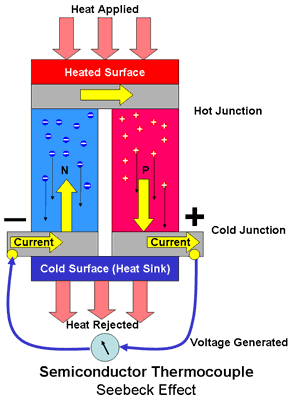
ü  And the Peltier will produce the different temperature each side of that module (Seebeck effect).
ü  When the value of the power supply is high, the different of each side temperature also high.

Diagram of Semiconductor Thermoelctric Module


And for measuring the output value produced from the Peltier, the ice have been used to get the 0o Celsius temperature. And the other temperature that have been used is the human body temperature, 37o Celsius. As a result, the output value reading that produced from that 2 different temperature on the Peltier have gain some voltage value, based on Seebeck Effect. So, to measure that output the multimeter have been set to 2V to measure the voltage gained from the Peltier. And the voltage that produced are around 500mV~600mV.

Lastly, based on the experiments the output value can be produce more, when the different of each side temperature are also high. The temperature of human body can be replaced with the other temperature that are more heat. As an improvement to gain more output value, it could be to using some heated object that can give more high temperature.

 Output voltage is 517mV

Output voltage is 588mV

Output voltage is 696mV
Conclusions:
           As a conclusion, the Thermoelectric Module can be operating when we supply the power and there will give some different temperature of the each side of that module. And this Thermoelectric Module can produce a small output value, and this part will combine with the other part for make sure all combined parts will give a high output value.
Receipt for Rare Earth Magnet

Friday, 10 February 2012

6 ~ 10 February 2012 (Week 4)

Title of Activity:
Project Progress.
ü  Purchased the project materials.

Objective:
Purchased the solar panel.
Purchased enamelled copper coils.
Purchased thermoelectric module (Peltier).

Content/Procedure:
For this week progress, the solar panel, enamelled copper coils and thermoelectric module (Peltier) have been purchased at Jalan Pasar.
At the same time, the component for the circuit also purchased together.
Measuring equipment and tools also have been purchased. 

Receipt  for Peltier and other tools
Receipt for Copper Coils
Receipt for Solar Panel
Result and Analysis:
            As a result, for this week there have showed some progress. The solar panel have been purchased, and the specification for this solar panel is:
ü  Max output power: 6W
ü  Max output voltage: 12V
ü  Max output current: 0.45A
ü  Dimension: 36x19x2cm
And for the enamelled copper coils, this material diameter is 0.32mm and those materials have been purchased a roll. And for the thermoelectric module (Peltier), this component converts the heat into electricity and the output maybe approximately around 10mV~50mV.
Picture of Thermoelectric Module (Peltier)
Picture of Enamelled Copper Coils
Picture of Solar Panel

Conclusions:
            From this week, the main component has been purchased. The solar panel are the important part because this part should be able to combine with the solar charger controller circuit. And for the thermoelectric module (Peltier), this component can be tested to measure the output produce during the next week.

Friday, 3 February 2012

30 January ~ 3 February 2012 (Week 3)

Title of Activity:
Project Progress.
ü  Development of Solar Charger Controller Circuit.

Objective:
Design circuit in the project board.
Sketch and design the solar charger controller circuit.

Content/Procedure:
Design the circuit using Multisim simulation application.
Testing the circuit using the project board.
Using the PCB designed, sketched the solar charger circuit.

Result and Analysis:
            As a result, for this week there have showed some progress. The solar charger controller circuit have been designed. Using the project board, the simple circuit have been designed. For the next week progress, maybe the solar panel should be purchased at the market and the circuit will be tested with the solar panel.
There have some problem if the design of solar charger controller circuit is very complex, maybe the electricity generated from the solar panel will be dropped. So to overcome this problems, the simple circuit have been designed for make sure that circuit can produced the electricity nicely.

Conclusions:
            To be concluded, the development of the solar charger circuit will make the project progress completed within the time that has been planned.
            This circuit for the solar charger can be tested when it finished fabricated. And the next step is to put the solar panel and the charged batteries, and then this project can be tested as one part of the whole project progress.